

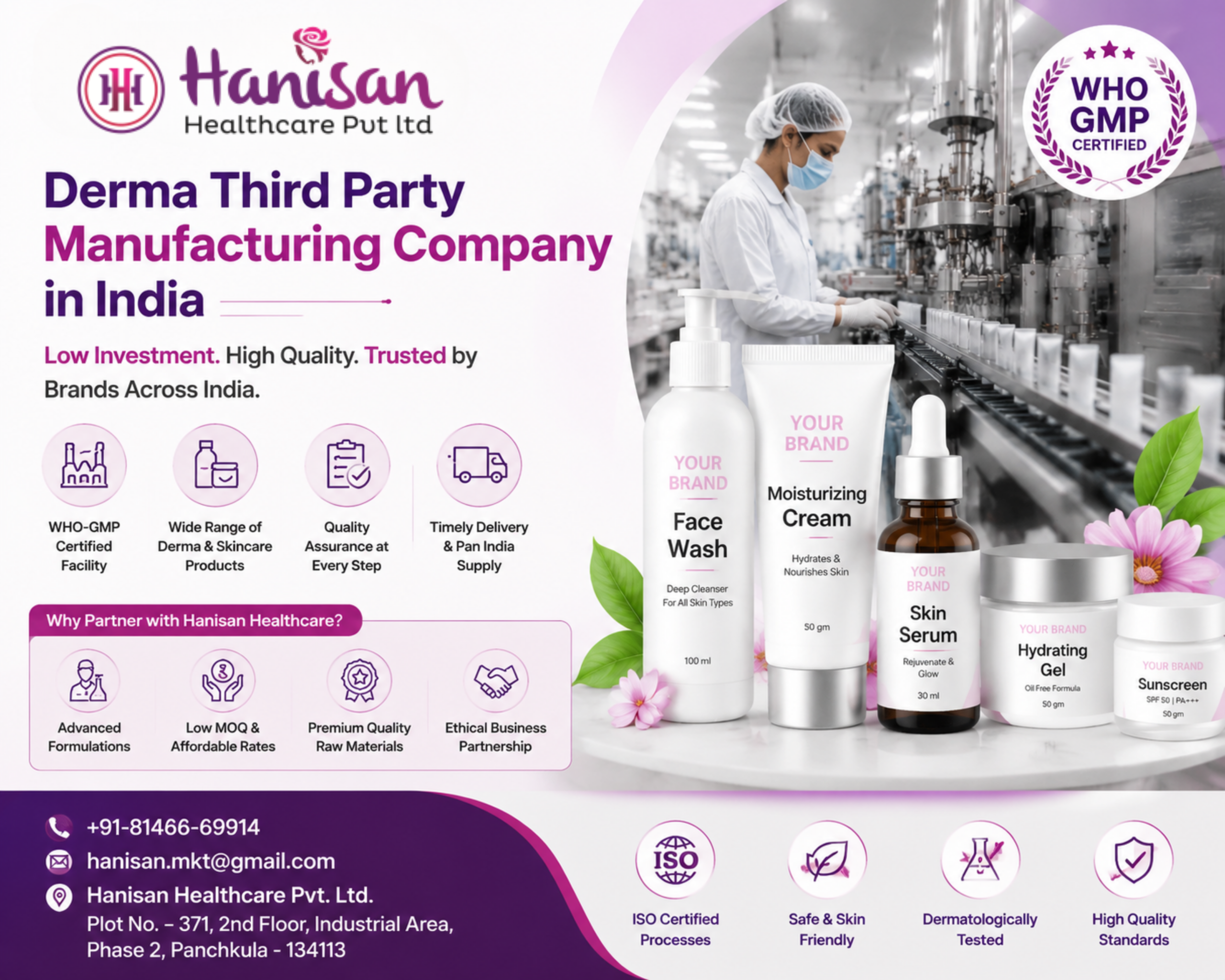
If you’ve typed “derma third party manufacturing company in india” into Google in the last few weeks, you’re probably standing at one of two points. Either you’re a distributor who wants to launch your own skincare line without building a factory. Or you already run a small derma business and you’re tired of your current manufacturer missing deadlines.
Either way, I’m going to save you some scrolling. My name’s associated with Hanisan Healthcare — we’ve been making derma, cosmetic, and pharma products out of Panchkula for years, and this guide is basically everything I wish someone had handed me when I started asking these same questions.
Fair warning: this is a long one. But by the end you’ll know exactly what a derma third party manufacturer actually does, what it costs, how to pick one without getting burned, and why Panchkula specifically has quietly become one of India’s biggest derma manufacturing hubs.
What Derma Third Party Manufacturing Actually Means
Let’s start simple. Derma third party manufacturing is when a company like Hanisan Healthcare makes skincare and dermatology products — creams, gels, lotions, serums, soaps, shampoos — and puts your brand name on them instead of ours. Our full product line is listed under our range.
You handle the sales, the marketing, the doctor visits, the Instagram page. We handle formulation, sourcing, production, quality testing, and packaging. It’s the same model that’s been running the pharma industry for decades, just applied to derma and cosmetic products.
Here’s the part most articles skip: this isn’t some shortcut for lazy entrepreneurs. Some of the biggest dermatology brands in India — the ones with products sitting in your bathroom right now — don’t own a single manufacturing plant. They design, they market, they sell. Someone else makes the tubes.
Why “Derma Third Party Manufacturing in Panchkula” Keeps Coming Up
Type that phrase into Google and you’ll notice something. A huge chunk of India’s derma manufacturing actually happens in and around Panchkula, Baddi, and the Himachal-Haryana pharma belt. There’s a reason for that, and it’s not an accident.
Panchkula sits in an industrial zone with tax incentives that pharma companies have used for years to set up GMP-compliant plants without the same overheads you’d face in Mumbai or Delhi NCR. That translates into lower manufacturing costs — which get passed down to you as lower per-unit pricing.
We’re based right here, at Plot No. 371, Industrial Area Phase 2, Panchkula. It’s not a coincidence that so many derma manufacturers cluster in this belt. Skilled labor is available, raw material suppliers are nearby, and the regulatory ecosystem — drug licensing offices, testing labs — is built around this exact industry. We also serve nearby pharma hubs including Baddi, Himachal Pradesh, and Karnal, plus distributors across Delhi, Mumbai, Chennai, and South India more broadly.
If you’re comparing a Panchkula-based manufacturer against one in a random city with no pharma cluster around it, ask yourself why. Usually the answer is cost, speed, or both.
Is This a Low Investment Derma Manufacturing Business? Let’s Talk Real Numbers
I’ll be straight with you, because most sites dance around this. You can realistically start a derma business through third party manufacturing with an investment somewhere between ₹2 lakh and ₹5 lakh. That covers your minimum order, basic packaging, and initial branding.
Compare that to setting up your own manufacturing unit. You’re looking at ₹2 crore to ₹5 crore and 12 to 18 months before you produce a single tube of cream. Third party manufacturing skips all of that.
A few numbers that matter when you’re budgeting:
- Minimum Order Quantity (MOQ): most manufacturers, us included, work with 500 to 1,000 units per product as a standard starting batch
- Timeline: formulation to delivery typically runs 30 to 50 days
- Licenses needed: a wholesale drug license and GST registration, at minimum, to legally sell derma products
- Margins: derma products commonly run 30% to 50%+ margins, higher than most general pharma categories
Low investment doesn’t mean low quality, though. That’s where people get it wrong. A ₹2 lakh entry point still needs to produce a product that survives dermatologist scrutiny and repeat customers. That’s where the manufacturer you pick actually matters.
Why “WHO GMP Certified Derma Manufacturer” Should Be Non-Negotiable
Here’s something I genuinely get worked up about. I’ve seen new entrepreneurs sign with manufacturers purely because the quote was ₹5 lower per unit, without checking a single certificate. That’s how you end up with a product recall, or worse, a batch that never should’ve left the factory.
WHO-GMP (Good Manufacturing Practices, as defined by the World Health Organization) isn’t a marketing sticker. It’s a set of enforced standards covering everything from raw material sourcing to hygiene protocols to how batches are tested before they ship. When a manufacturer holds this certification, it means an external body has actually inspected their process, not just their brochure.
Hanisan Healthcare operates under WHO-GMP and ISO quality standards. What that means for you practically:
- Raw materials are sourced and verified before they touch a formulation
- Every batch goes through quality testing before packaging
- Our manufacturing units follow documented, auditable processes — not “we’ve always done it this way”
- Products are stable enough to survive Indian climate extremes, from Delhi heat to Kerala humidity
When you’re evaluating any derma third party manufacturer, ask for their certificate numbers. Not “are you certified” — ask for the actual DCGI, ISO 9001:2015, and WHO-GMP documentation. A real manufacturer hands it over without hesitation.
How to Start a Derma Third Party Manufacturing Business: Step by Step
Okay, let’s get practical. Say you’ve decided this is the route you want. Here’s how it actually plays out, start to finish.
Step 1: Get your paperwork in order. You’ll need a wholesale drug license (Form 20B/21B depending on your state) and GST registration before any legitimate manufacturer will sign a contract with you. This part trips up a lot of first-timers — start it early, it takes a few weeks.
Step 2: Decide your product range. Don’t try to launch 20 SKUs on day one. Pick 4-6 products that solve one clear problem — acne, pigmentation, dryness, sun protection — and launch tight. You can always expand once the first batch sells.
Step 3: Shortlist manufacturers and actually vet them. Look past the website. Ask for their certifications, their MOQ, their turnaround time, and — this is the part people skip — ask to see samples of products they’ve made for other brands. A manufacturer proud of their work will show you.
Step 4: Finalize formulation and packaging. This is where a good manufacturer earns their fee. You should be able to request tweaks to texture, fragrance, and active ingredients, and get real packaging mockups before committing to a full production run.
Step 5: Place your first order. Confirm your MOQ, get a written timeline, and get everything — pricing, quantities, delivery date — in writing. Verbal promises don’t hold up when a shipment’s late.
Step 6: Receive, inspect, and launch. Once your batch arrives, check it against the agreed specs before it goes to market. Then it’s on you — sales, marketing, distribution.
Step 7: Reorder and scale. If the first batch sells well, this is where the low-investment model really pays off. You’re not waiting on factory capacity you own — you scale production simply by placing a bigger order.
Derma Third Party Manufacturing vs Cosmetic Third Party Manufacturing: What’s the Difference?
People use these terms interchangeably and it causes confusion, so let’s clear it up quickly.
Derma products are formulated to treat or manage a skin condition — acne, fungal infections, pigmentation, eczema — and often fall under drug regulations because they contain active pharmaceutical ingredients. Cosmetic products are formulated for appearance and general skin maintenance — regular moisturizers, basic soaps, everyday shampoos — with lighter regulatory requirements.
The practical difference for you: derma product manufacturing usually needs a drug license and more rigorous testing. Cosmetic manufacturing has a shorter regulatory path. At Hanisan, we manufacture both ranges — see our drug range and cosmetic range — which means you’re not stuck picking two separate manufacturers if your brand plans to eventually cover both categories. We also offer herbal, ayurvedic, and nutraceutical manufacturing under the same roof, and if you’d rather run a franchise model instead of your own brand, we also offer a PCD pharma franchise route.
Real Numbers: What Working With a Panchkula Manufacturer Looks Like
Case Study 1 — Regional Distributor, North India A pharma distributor came to us wanting to launch a 5-product derma range under his own brand. Starting investment: ₹3.2 lakh. First order: 800 units across 5 SKUs. Delivery: 38 days from formulation approval to dispatch. Within 4 months, he’d reordered twice, scaling to 2,500 units per batch.
Case Study 2 — D2C Startup Entering Offline Retail An online-first skincare brand wanted to enter chemist retail, which meant they needed drug-license-compliant derma SKUs, not just cosmetic ones. We reformulated two of their bestsellers into derma-grade versions with proper documentation. Their retail margin improved by 18% compared to their previous outsourced manufacturer, mainly from Panchkula’s lower base production cost.
Case Study 3 — South India Expansion A Chennai-based pharma marketer wanted a derma range stable enough for South India’s heat and humidity. We ran additional stability testing under high-heat, high-humidity conditions before finalizing the formulation — something a lot of manufacturers skip. Zero product complaints in the first 6 months post-launch across three states.
Why Brands Choose Hanisan Healthcare Specifically
There are dozens of derma third party manufacturers in the Panchkula-Baddi belt. So why us. Honestly, a few reasons that keep coming up when clients tell us why they stayed:
We’re not a directory listing or a marketing shell — we operate our own manufacturing units, with WHO-GMP and ISO-backed processes, so there’s no middleman markup between you and the factory floor. Our MOQs start low enough that a first-time entrepreneur with ₹2-3 lakh can genuinely get started, not just brands with deep pockets. We handle both derma and cosmetic ranges under one roof, so you’re not managing two vendor relationships. And because we’re based directly in Panchkula’s industrial belt, our turnaround times — 30 to 50 days from formulation to delivery — beat manufacturers working out of costlier, less specialized locations.
We also do something most competitors don’t bother with: full customization on formulation, packaging, and labeling — including face wash, ointments, and more — backed by real R&D, not a catalog of 40 pre-made products you’re forced to pick from. You can also learn more about our manufacturing capabilities, our approach to quality, and our broader expertise.
Frequently Asked Questions
What is derma third party manufacturing? It’s when a certified manufacturer like Hanisan Healthcare produces derma and skincare products under your brand name, handling formulation, production, and packaging while you handle sales and marketing.
How much investment do I need to start a derma manufacturing business? Most entrepreneurs start between ₹2 lakh and ₹5 lakh, covering the minimum order quantity, packaging, and initial branding costs.
What is the minimum order quantity (MOQ) for derma products? Standard MOQs run 500 to 1,000 units per product, though this varies by manufacturer and product complexity.
How long does it take from formulation to delivery? Typically 30 to 50 days, depending on the number of SKUs and any custom formulation requests.
Do I need a drug license to sell derma products? Yes. A wholesale drug license and GST registration are required to legally market and sell derma products in India.
Why is Panchkula a hub for derma manufacturing? Panchkula sits within a well-established pharma industrial belt with tax advantages, skilled labor, and proximity to raw material suppliers — which keeps manufacturing costs lower without compromising quality.
What’s the difference between WHO-GMP and ISO certification? WHO-GMP certifies that manufacturing processes meet World Health Organization production standards. ISO 9001:2015 certifies overall quality management systems. Reputable manufacturers, including Hanisan, hold both.
Can I customize the formulation and packaging? Yes. A good third party manufacturer should let you adjust texture, active ingredients, fragrance, and packaging design before committing to a full production run.
What’s the difference between derma and cosmetic third party manufacturing? Derma products treat specific skin conditions and often require a drug license; cosmetic products focus on general appearance and skin maintenance with lighter regulatory requirements.
How do I choose the right derma third party manufacturing company? Check their certifications (WHO-GMP, ISO, DCGI approval), ask for MOQ and turnaround time in writing, request product samples, and confirm they offer real formulation customization — not just a fixed catalog.
Can a new entrepreneur with no pharma background start this business? Yes. Many of our clients started with zero manufacturing experience. The manufacturer handles the technical and regulatory side; you focus on sales and brand-building.
What products fall under derma third party manufacturing? Creams, gels, ointments, lotions, serums, soaps, shampoos, sunscreens, and dusting powders for conditions like acne, pigmentation, and fungal infections.
Ready to launch your derma brand? Talk to Hanisan Healthcare — WHO-GMP certified derma third party manufacturing, based in Panchkula. Visit our contact page or call Mr. Manish at +91-81466-69914 or Mr. Jyot Karan Singh at +91-7087731375.
#DermaThirdPartyManufacturing #PanchkulaPharma #WHO-GMPDermaManufacturer #DermaPCDBusiness #SkincareContractManufacturing