

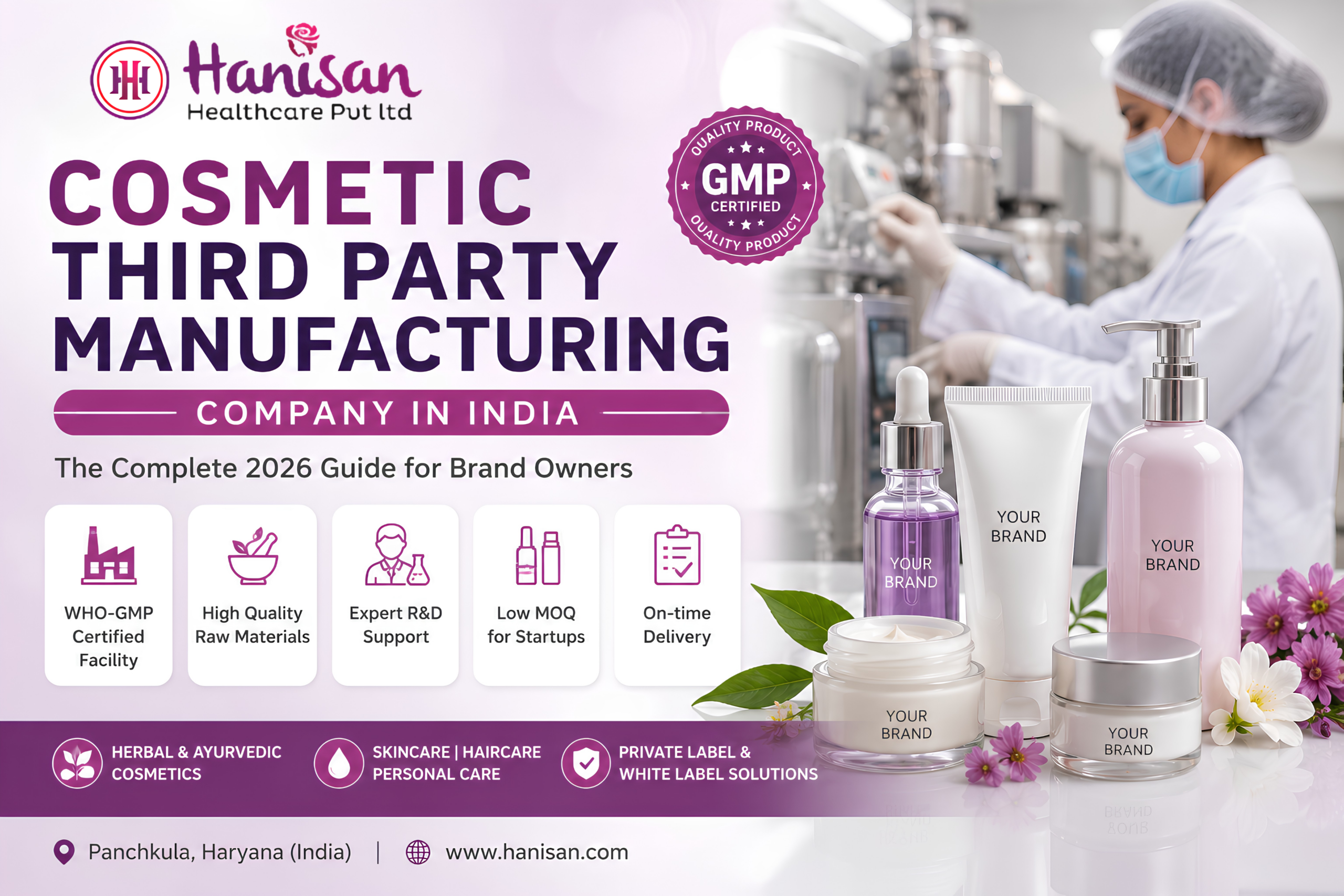
I’ve talked to a lot of people who want to start a cosmetic brand. Almost all of them start with the same question: “Do I need my own factory?”
No, you don’t. And honestly, in 2026, most successful skincare and beauty brands in India don’t own one either. They partner with a cosmetic third party manufacturing company that already has the plant, the chemists, the licenses, and the batch history to get a product from formula to shelf without you spending crores on infrastructure.
This guide walks through everything — what third party manufacturing actually means, how it’s different from private label, what GMP certification really guarantees, what low MOQ options look like for startups, and how a company like Hanisan Healthcare fits into all of it. Grab a coffee. It’s a long one, but I’ve tried to keep it useful, not fluffy.
What Is Cosmetic Third Party Manufacturing Company in India, Really?
A cosmetic third party manufacturing company in India is a business that produces cosmetics — creams, serums, gels, lotions, soaps, shampoos — under someone else’s brand name. You bring the idea. They bring the plant.
Here’s the part people miss: it’s not just “outsourced production.” A good third party manufacturer also handles formulation tweaks, raw material sourcing, stability testing, and regulatory paperwork. You’re not just renting a factory floor. You’re borrowing an entire R&D and compliance team.
Hanisan Healthcare works this way for cosmetic and derma clients across India. We’re based in Panchkula, right in the Tricity belt, which happens to be one of India’s biggest pharma and cosmetic manufacturing hubs — Baddi and Himachal Pradesh are a short drive away, and that region alone produces a huge share of the country’s dermatology and skincare output.
Why does the model work so well for new brands? Cost, mostly. Building a GMP-compliant cosmetic plant from scratch costs anywhere from 50 lakh to several crores, depending on scale. Partnering with an existing third party manufacturing company means you skip that entirely and start selling within weeks instead of years.
There’s a trust angle too. Buyers — especially pharmacies, dermatologists, and modern trade retailers — actually check for manufacturing credentials before stocking a product. A brand backed by a WHO-GMP facility clears that bar automatically.
Third Party Cosmetic Manufacturer in India vs Doing It Yourself
I get asked this constantly: “Should I just build my own small unit instead?”
Here’s my honest take. Unless you’re planning to manufacture at massive scale — think tens of lakhs of units a month — building in-house rarely makes financial sense in year one or two. You’d be paying for a full-time QC team, machinery maintenance, license renewals, and idle capacity during slow months. A third party cosmetic manufacturer in India spreads all of that cost across many brands, which is exactly why the per-unit price stays low for you.
What should you actually look for in a manufacturer? A few non-negotiables:
- A drug/cosmetic manufacturing license issued by the state licensing authority
- GMP and ISO certification (more on this below)
- An in-house or tie-up R&D lab for formulation changes
- Batch traceability and stability testing records
- Reasonable turnaround time — 20 to 35 days is standard for most cosmetic categories
Hanisan Healthcare checks all five. We manufacture creams, serums, gels, ointments, lotions, shampoos, soaps, and face washes across our cosmetic range, with full documentation support for every batch.
One thing I’ll say plainly: don’t pick a manufacturer just because they quote the lowest price. I’ve seen brands get burnt by inconsistent batches from cut-rate manufacturers, and by the time they realize it, they’ve already shipped bad stock to distributors. Reputation and consistency matter more than saving two rupees a unit.
Private Label Cosmetic Manufacturer in India: What’s the Real Difference?
Private label and third party manufacturing get used interchangeably, but they’re not quite the same thing, and the distinction actually matters for your business plan.
Third party manufacturing usually means you supply your own formula, or work with the manufacturer to develop a custom one, and they produce it exclusively for your brand. A private label cosmetic manufacturer in India, on the other hand, often has ready-made “base” formulations that multiple brands can license, then customize packaging and branding on top.
Which one’s better for you? Depends on your stage.
If you’re launching fast and want to test the market with minimal risk, private labeling with an existing formula gets you to market in days, not months. If you want a truly differentiated product — a unique actives combination, a specific fragrance profile, a formulation nobody else has — custom third party manufacturing is the way to go, even though it takes longer.
At Hanisan, we do both. Brands can pick from our existing derma and cosmetic product range — things like our Kojibute Cream or Hanisun Sunscreen Lotion — and rebrand them, or come to us with a completely custom formulation request through our R&D team.
Honestly, most first-time founders underestimate how much a good base formula can save them. Reformulating from scratch isn’t cheap, and it isn’t fast. Sometimes the smart move is to start with something proven and put your energy into branding and marketing instead.
GMP Certified Cosmetic Manufacturing Company: Why This Isn’t Just a Checkbox
I want to be direct about this one because a lot of blogs treat GMP certification like a marketing sticker. It’s not. It’s the difference between a product that’s safe and one that isn’t.
GMP — Good Manufacturing Practices — is a set of standards covering everything from raw material storage temperature to equipment cleaning logs to how workers handle the product on the line. A GMP certified cosmetic manufacturing company has to document all of it, and that documentation gets audited.
Why should a brand owner care? Because if your product causes a skin reaction and you can’t produce batch records, you’re legally exposed. If your manufacturer follows GMP properly, every batch is traceable back to raw material lot numbers, testing results, and the exact machine and shift it was made on.
Hanisan operates under WHO-GMP standards across our facilities, covering both our drug range and cosmetic range. You can check the specifics of our quality processes here.
Here’s a tip: when a manufacturer says “GMP certified,” ask which body certified them and ask to see the certificate. A real WHO-GMP facility won’t hesitate to share it. If they get vague or dodge the question, that’s your answer.
Low MOQ Cosmetic Manufacturer in India: Making Sense of Minimum Order Quantities
MOQ trips up more first-time brand owners than anything else on this list. You’ll see manufacturers quoting MOQs anywhere from 500 units to 10,000 units per SKU, and the number genuinely matters for your cash flow.
A low MOQ cosmetic manufacturer in India lets you order smaller batches — usually 500 to 1,000 units — so you’re not sitting on unsold inventory while you’re still figuring out what your customers actually want. This matters a lot for D2C and salon-focused brands testing multiple SKUs before committing budget to one winner.
Here’s the trade-off nobody tells you upfront: lower MOQ usually means a slightly higher per-unit cost, because the manufacturer can’t spread fixed costs across as many units. That’s fine. Treat the first order as market research, not a profit center.
At Hanisan, we work with both first-time entrepreneurs testing the waters and established brands scaling up, adjusting MOQ based on product category and packaging complexity. If you’re not sure what quantity makes sense for your launch, that’s genuinely worth a phone call before you commit to anything — reach out to our team and we’ll walk you through realistic numbers based on what you’re selling and where.
Cosmetic Contract Manufacturing in India: How the Process Actually Works
People imagine contract manufacturing as “hand over a recipe, get a box of product.” It’s a bit more involved than that, and knowing the steps helps you plan your launch timeline realistically.
Step 1 — Concept and formulation. You either bring your own formula or brief the manufacturer’s R&D team on what you want the product to do — brightening, anti-acne, anti-aging, whatever your positioning is.
Step 2 — Sample development. The lab develops 2-3 sample variants. This stage usually takes 7-15 days.
Step 3 — Testing and approval. You test texture, fragrance, and performance. Adjustments happen here.
Step 4 — Packaging and compliance. Labels get finalized to match FSSAI, BIS, or CDSCO requirements depending on the product category.
Step 5 — Bulk production. Once everything’s signed off, the manufacturer runs the full batch — typically 20-35 days for cosmetic categories.
Step 6 — QC and dispatch. Every batch goes through stability and microbial testing before it ships.
Cosmetic contract manufacturing in India, done right, usually gets a brand from concept to shelf-ready stock in six to ten weeks. Hanisan’s manufacturing operations follow this exact structure, and we keep clients updated at each stage instead of going quiet until the batch is done — which, honestly, is a bigger deal than it sounds. A lot of manufacturer complaints I’ve heard aren’t about product quality. They’re about radio silence during production.
Herbal and Ayurvedic Cosmetic Manufacturer: India’s Real Advantage
If there’s one category where Indian cosmetic manufacturing genuinely leads the world, it’s herbal and ayurvedic formulations. Access to neem, turmeric, aloe vera, saffron, and ashwagandha isn’t something manufacturers in Europe or the US can replicate easily, and Indian consumers increasingly want ingredient transparency and “clean” positioning anyway.
A herbal and ayurvedic cosmetic manufacturer blends traditional ingredient knowledge with modern GMP-standard production — so you get the marketing story of botanicals plus the safety guarantees of a certified facility. That combination sells, especially in tier 2 and tier 3 markets where ayurvedic trust runs deep.
Hanisan manufactures across both conventional and ayurvedic third party lines, along with a dedicated herbal products range. If your brand story leans natural or ayurvedic, this is the kind of manufacturer relationship where the formulation team’s botanical knowledge genuinely shapes how good your final product turns out, not just how it’s marketed.
Skincare Private Label Manufacturer: Choosing the Right Product Categories
Not every skincare category performs the same in the Indian market, and picking your first SKUs matters more than people think.
Face washes and sunscreens tend to have the fastest repeat-purchase cycles, which is great for cash flow. Serums carry higher margins but need stronger brand storytelling to justify the price point. Creams and lotions sit somewhere in between — steady demand, moderate margin, easier to formulate at scale.
A skincare private label manufacturer worth working with will tell you this honestly instead of just taking whatever order you place. We’ve had conversations with clients at Hanisan where we’ve actively suggested starting with two or three SKUs instead of eight, purely because spreading a limited marketing budget across too many products from day one rarely works.
Our cream, serum, gel, and lotion lines cover most of what a new skincare brand needs to launch a focused, coherent first collection.
White Label Cosmetic Manufacturer India: When It’s the Faster Route
White label is private label’s speedier cousin. Instead of any customization at all, you’re literally putting your logo on an existing, unmodified formula. Zero R&D time, fastest possible launch.
A white label cosmetic manufacturer in India makes sense when speed matters more than differentiation — say, you’re launching a gifting line for a festival season, or testing a new market segment before investing in custom development. It’s not a long-term brand strategy on its own, but as a fast, low-risk entry point, it works.
Hanisan supports white label requests across select product categories in our range, especially for clients who want to validate demand before committing to custom formulation costs.
Cosmetic Manufacturer in Chandigarh, Panchkula & the Tricity Region
If you’re based in North India — Chandigarh, Mohali, Panchkula, Zirakpur, or anywhere across Punjab, Haryana, or Himachal — working with a local manufacturer has real, practical advantages that people outside the region don’t always appreciate.
Shorter lead times for sample pickups. Easier factory visits before you commit. Lower freight costs on bulk shipments. And frankly, it’s a lot easier to build trust with a manufacturer you can actually sit across a table with.
Hanisan Healthcare is headquartered in Panchkula’s Industrial Area, Phase 2 — right in the heart of the Tricity’s pharma and cosmetic manufacturing belt, a short distance from Baddi’s massive formulation hub. We also serve clients across Haryana, Delhi, Himachal Pradesh, and beyond, but for brand owners in this region specifically, being able to drop by the plant makes the whole relationship easier to manage.
Best Cosmetic Manufacturer for Startups: What Actually Matters at Your Stage
Startups have different priorities than established brands, and a manufacturer that’s great for a 10-crore company might be the wrong fit for someone launching their first three SKUs.
What actually matters when you’re small: flexible MOQ, willingness to have a real conversation instead of pushing you toward a sales pitch, transparent costing with no hidden charges, and a manufacturer who won’t deprioritize your order the moment a bigger client calls.
That last point is bigger than it sounds. Small brands often get pushed to the back of the production queue at manufacturers who chase only large accounts. Ask directly how they prioritize orders across client sizes before you sign anything.
Hanisan works with entrepreneurs at every stage — from a first-time founder ordering 500 units to established players running multi-lakh unit programs — and we treat both with the same production discipline. Check our about us page if you want a sense of the scale we operate at.
Cosmetic Manufacturing Cost and MOQ in India: What to Actually Budget For
Nobody likes vague pricing, so let’s talk numbers in ranges, since exact costs depend on formulation complexity, packaging, and order size.
Basic cream or lotion formulations typically run somewhere between ₹40-120 per unit at moderate MOQs, before packaging. Serums, given the actives and packaging involved, usually land higher — ₹80-250 per unit. Soaps and face washes tend to be the most affordable entry point.
Beyond the per-unit product cost, budget for: packaging development (₹15,000-60,000 depending on complexity), regulatory documentation and testing (often bundled into the manufacturing quote), and your first marketing push, which usually needs to match or exceed your manufacturing spend if you actually want the stock to move.
The honest advice here: get itemized quotes from at least two or three manufacturers before deciding. Not to squeeze the cheapest price out of anyone, but because seeing the breakdown tells you a lot about how transparent a manufacturer actually is.
How to Choose a Cosmetic Third Party Manufacturer in India: A Step-by-Step Guide
If you take one section of this guide seriously, make it this one.
1. Verify the license first. Ask for their state drug/cosmetic manufacturing license number. This is public information — you can cross-check it if needed.
2. Confirm GMP and ISO status. Request the actual certificate, not just a claim on the website.
3. Ask about MOQ flexibility. Don’t assume — get it in writing for your specific product category.
4. Review their existing product range. A manufacturer already producing similar products to yours will have fewer teething issues with your formula.
5. Ask about turnaround time honestly. If every answer is “as fast as you need,” be suspicious. Real manufacturing has real timelines.
6. Check documentation support. Will they provide COA (Certificate of Analysis), stability data, and MSDS sheets? You’ll need these for retail and export.
7. Talk to an existing client if you can. Word of mouth in this industry is more reliable than any website copy, including this one.
8. Visit the facility if it’s feasible. Nothing replaces seeing the production floor with your own eyes.
Go through this checklist with any manufacturer you’re evaluating, including us. We’d rather you ask hard questions upfront than discover a problem three months into the relationship.
Case Study 1: A Delhi-Based Skincare Startup’s First 90 Days
A small D2C skincare brand based in Delhi came to a Tricity-region manufacturer with a single SKU idea — a niacinamide face serum — and a modest first order of 800 units. Within their first 90 days, they focused entirely on that one product instead of spreading budget thin across a full range.
By keeping MOQ low and reinvesting margin into targeted Instagram ads rather than a bigger product catalog, they sold through their first batch in 11 weeks and reordered at double the quantity. Their manufacturer’s willingness to accommodate a small first order, rather than pushing a 5,000-unit minimum, was the single biggest factor in them being able to launch at all on a limited budget.
Case Study 2: A Salon Chain’s Private Label Expansion
A 6-outlet salon chain in North India wanted to sell branded hair and skincare products at the counter instead of generic third-party brands. They partnered with a private label manufacturer for four SKUs — a hair serum, a face wash, a body lotion, and a sunscreen — using existing base formulations with custom fragrance and packaging.
The result: in-house product sales added roughly 18% incremental revenue per outlet within six months, purely from customers who trusted the salon’s own brand more than shelf products they could buy anywhere. The key decision that made this work was choosing categories the salon’s clients already asked about most, rather than guessing at a broader range.
Case Study 3: An Ayurvedic Brand’s Regional Rollout
A small ayurvedic skincare label based in Haryana wanted to expand from online-only sales into regional pharmacy chains. Their manufacturer’s WHO-GMP certification and documented batch traceability became the deciding factor for pharmacy buyers who’d previously rejected two other suppliers over incomplete documentation.
Within four months of switching manufacturers, the brand secured shelf space in over 40 pharmacy outlets across two states — something that had stalled for nearly a year under their previous, uncertified supplier.
Frequently Asked Questions
1. What is the minimum investment needed to start a cosmetic brand in India? With a low MOQ manufacturer, you can realistically launch a single SKU with an investment starting around ₹1-3 lakh, covering manufacturing, packaging, and basic branding.
2. How long does cosmetic third party manufacturing take from order to delivery? Most cosmetic categories take 20-35 days for bulk production after sample approval, plus 1-2 weeks for the sampling stage itself.
3. Do I need a drug license to sell cosmetics in India? Cosmetics generally require FSSAI or BIS compliance depending on category, while the manufacturer needs a cosmetic manufacturing license from the state licensing authority. Your manufacturer should guide you through what applies to your specific product.
4. What’s the difference between third party and private label manufacturing? Third party manufacturing typically involves a custom or brand-specific formula made exclusively for you. Private label often uses a base formula shared across brands, customized with your packaging and branding.
5. Can I get samples before placing a bulk order? Yes — any credible manufacturer, including Hanisan, will provide samples for approval before committing to a full production run.
6. What is WHO-GMP certification and why does it matter? It’s a globally recognized standard confirming the manufacturing facility follows strict quality, hygiene, and documentation practices. It matters because it protects both consumer safety and your legal standing as a brand owner.
7. Is herbal or ayurvedic cosmetic manufacturing more expensive? Not necessarily. Cost depends more on the specific actives and packaging than on whether the formulation is herbal-based.
8. Can a small startup work with a large cosmetic manufacturer? Yes, as long as the manufacturer offers low MOQ options. Ask directly about their smallest possible order size before assuming you’re too small to work with them.
9. What documentation should I receive with each batch? At minimum, a Certificate of Analysis (COA), and ideally stability test data and an MSDS sheet, especially if you plan to sell through pharmacies or export.
10. Does Hanisan Healthcare manufacture both drug and cosmetic products? Yes. Hanisan operates across derma, cosmetic, herbal, and nutraceutical manufacturing, along with a full PCD pharma franchise division.
11. How do I get a manufacturing quote from Hanisan? You can contact our team directly or reach out on WhatsApp for a quick response with pricing based on your product category and quantity.
Final Thoughts
Picking a cosmetic third party manufacturing company in India isn’t just a production decision. It shapes your product quality, your compliance standing, and honestly, how fast you can actually get to market. Take the checklist in this guide seriously, ask the uncomfortable questions early, and don’t let a low quote talk you out of due diligence.
If you’re based anywhere near the Tricity region, or just want a manufacturer with WHO-GMP credentials and genuine flexibility for smaller orders, get in touch with Hanisan Healthcare. We’d rather answer your questions upfront than have you find out the hard way three months in.