

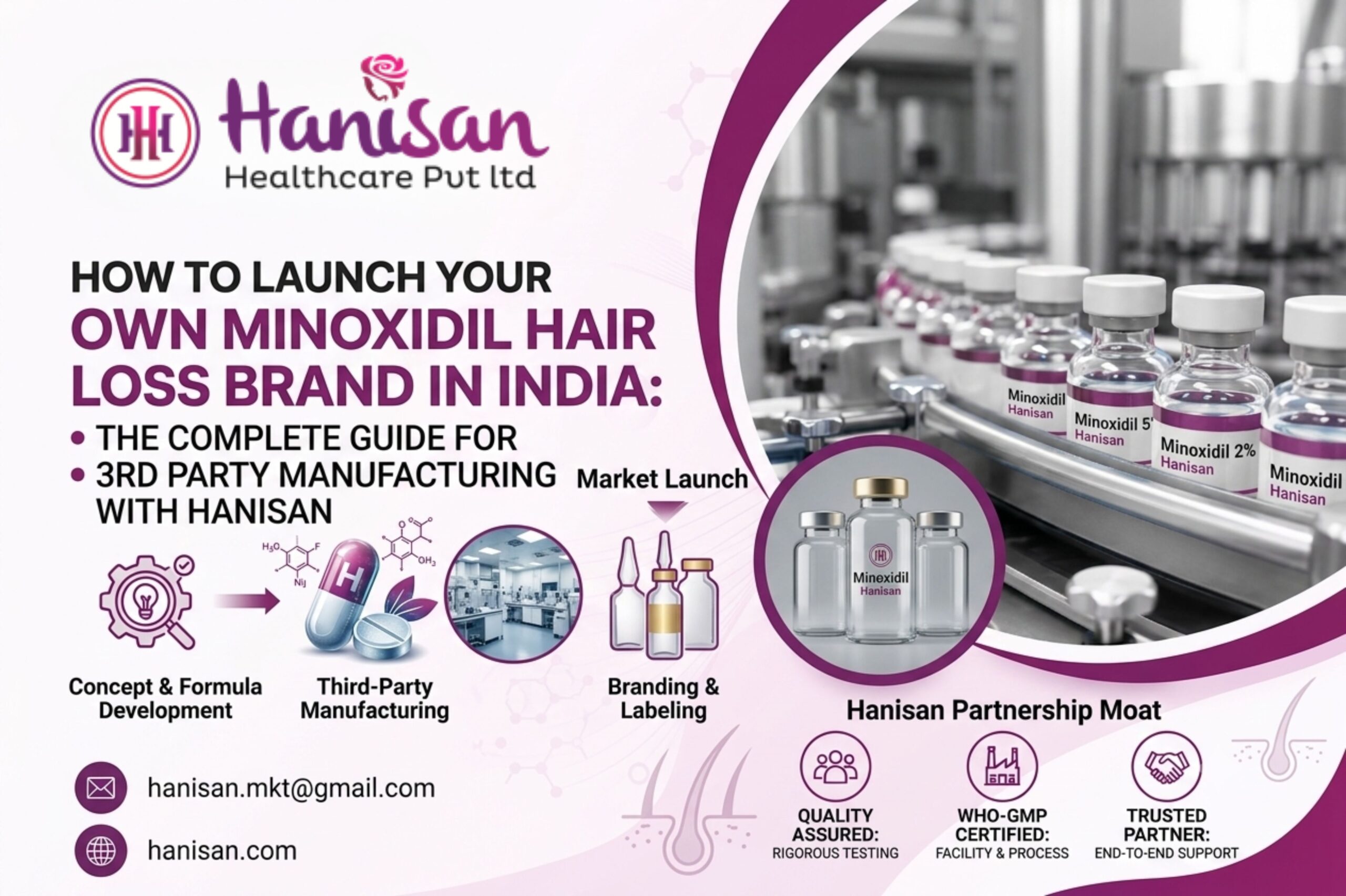
The hair loss market in India is booming. Worth ₹2,500+ crores and growing at 11% CAGR, minoxidil-based products dominate the clinical dermatology segment. Yet most entrepreneurs don’t know where to start.
You don’t need a factory. You don’t need huge capital. You need the right 3rd party manufacturer.
Hanisan Healthcare manufactures minoxidil solutions for brands across India—from startups launching their first product to established brands scaling up. But launching a successful minoxidil brand isn’t just about manufacturing. It’s about understanding formulations, market positioning, regulatory requirements, and what actually sells.
This guide covers everything a brand founder needs to know—from choosing the right strength and formulation to manufacturing timelines, regulatory approvals, and go-to-market strategy. Whether you’re starting a PCD franchise, direct-to-consumer brand, or wholesale distribution, this is your roadmap.
Why Minoxidil? Understanding the Market Opportunity
Before you manufacture, understand why minoxidil-based products are a goldmine for 3rd party manufacturers.
Market Size & Growth
The Indian dermatology market is exploding. Hair loss treatments alone represent a ₹800+ crore segment, with minoxidil solutions accounting for 35-40% of all topical hair loss prescriptions.
Key data:
- 60-70% of minoxidil users see visible improvement (clinical backing = trusted by doctors)
- Prescription patterns skew toward minoxidil 5% (best price-to-efficacy ratio)
- Combination products (minoxidil + finasteride, minoxidil + biotin) growing 25% YoY
- PCD franchise model for derma products seeing 18% growth (distributed through rural India)
Why this matters for your brand: Minoxidil has clinical credibility. Dermatologists recommend it. There’s consistent, year-round demand. Unlike trendy skincare, hair loss treatment is non-discretionary—people will pay for results.
Why 3rd Party Manufacturing?
You could try to build your own factory. You’d need:
- ₹50-100 lakhs capital investment
- WHO-GMP certification (2-3 years process)
- Regulatory approvals (DCGI, state licenses)
- Hiring skilled chemists and production staff
- Managing QA, batch testing, supply chain
Or you could partner with Hanisan.
What 3rd party manufacturing gives you:
- Pre-certified facility (WHO-GMP, ISO, FDA approved)
- Regulatory experience (they handle documentation)
- Quality assurance (batch testing, stability studies)
- Flexible MOQ (minimum order quantities suited for startups)
- Fast turnaround (6-8 weeks from approval to delivery)
- Focus on branding & sales (not manufacturing headaches)
This is how 90% of successful derma brands in India started.
Choosing Your Minoxidil Formulation
This is the strategic decision. Get it right, and you’ll have a repeatable product. Get it wrong, and you’ll be stuck with inventory that doesn’t sell.
Minoxidil Strength: What to Manufacture?
You have three options. Each targets different customer segments and has different margins.
Option 1: Minoxidil 5% (Recommended for First Launch)
Why: This is the workhorse. 60% of the minoxidil market uses 5% strength. Most dermatologists start prescriptions here. Best price-to-demand ratio.
Target customer: Men aged 25-45 with moderate androgenetic alopecia. The mainstream segment.
Market size: Largest. Every pharmacy stocks minoxidil 5%.
Pricing: Brands sell for ₹1,100–₹1,800 per 60ml bottle. Manufacturing cost ~₹250-350 (you keep the spread).
Competition: HIGH. Mintop Forte (Dr. Reddy’s), Tugain (Cipla), Morr (Intas), Kera, Regaine dominate. But there’s room for sub-brands and regional players.
Strategic angle: Don’t compete on price. Differentiate through:
- Better packaging (spray vs dropper)
- Alcohol-free formulation (foam variant)
- Added supporting actives (biotin, niacinamide, procapil)
- Stronger dermatologist relationships
- Direct-to-consumer branding (Instagram, doctor partnerships)
Recommendation for new brands: YES. Launch with minoxidil 5% as your flagship. Build distribution and brand trust first.
Option 2: Minoxidil 2% (Women’s Segment / Premium Positioning)
Why: Growing segment. Specifically marketed to women (safer, fewer side effects). Also positioning for premium, “dermatologist-recommended” brands.
Target customer: Women aged 25-50, men with sensitive scalps, first-time users.
Market size: 15-20% of total minoxidil market. Smaller but premium-priced.
Pricing: Brands sell for ₹1,200–₹2,000 per 60ml (higher price per ml than 5%). Manufacturing cost ~₹200-300.
Competition: Moderate. Most brands don’t make dedicated 2% because men’s segment is bigger. Less crowded market = easier to build brand.
Strategic angle: Position as “gentler, dermatologist-preferred for women.” Build partnerships with gynecologists and women-focused dermatology clinics. Direct messaging to female influencers in wellness space.
Recommendation for new brands: CONDITIONAL. If you already have network in women’s healthcare or direct-to-consumer capability, yes. Otherwise, combine with 5% as a two-SKU launch.
Option 3: Minoxidil 10% (Specialist / Advanced Loss)
Why: Only 5-10% of market. But the people who use it are desperate (established baldness, non-responders to 5%). They’ll pay premium prices.
Target customer: Men aged 35-60 with severe baldness, those who’ve tried 5% with limited results, dermatologists recommending combination therapy.
Market size: Smallest. But high per-unit margin.
Pricing: Brands sell for ₹1,800–₹2,500 per 60ml. Manufacturing cost ~₹300-400.
Competition: Minimal. Only major brands make 10%.
Strategic angle: Position as “prescription-strength, dermatologist-only.” Sell through dermatology clinics, not retail pharmacies. Build as a premium tier for your existing 5% users.
Recommendation for new brands: NO, unless you already have 5% established. Start with 5%, add 10% as tier-2 product after 6-12 months.
Formulation Choice: Pure vs. Combination
Pure minoxidil (just the active) vs. combinations (minoxidil + supporting ingredients).
Pure Minoxidil 5%
What it is: Minoxidil + alcohol + water + standard excipients. That’s it.
Cost: ₹250-320 per unit (lowest)
Efficacy: Clinically proven. 60-70% user satisfaction.
Differentiation: HARD. Every competitor makes this. Price competition only.
Margin: Lowest (customers expect cheaper prices for basic products)
When to choose: If you have established dermatologist network and can sell through prescription channels (doctors recommend YOUR brand specifically). Or if building volume play (deep distribution, high turnover, thin margins).
Minoxidil 5% + Finasteride 0.1% (Combination)
What it is: Minoxidil + DHT-blocker. Dual-action. Men only.
Cost: ₹350-450 per unit (30% more)
Efficacy: Superior. 40-50% improvement vs 20-30% with minoxidil alone.
Differentiation: YES. Positions you as “advanced solution.” Can charge premium.
Margin: Higher. Doctors recommend combinations as “gold standard.”
Barrier: Requires prescription (finasteride is Rx-only). But that’s a moat—prevents pure retail competition.
When to choose: If you have relationships with dermatologists (your B2B customer). Combination products are doctor-prescribed, not OTC, so you control the channel.
Minoxidil 5% + Biotin + Niacinamide (Supporting Ingredients)
What it is: Minoxidil + hair-health supporting actives.
Cost: ₹320-400 per unit (35% more)
Efficacy: Minoxidil does the heavy lifting. Supporting ingredients are marketing angle.
Differentiation: Medium. “Holistic” positioning. Appeals to wellness-conscious users.
Margin: Medium-high. Can charge 20-30% premium.
Barrier: Easy for competitors to copy.
When to choose: If building direct-to-consumer brand (online, Instagram, wellness influencers). Supporting ingredients = story. Story sells on social media.
Hanisan’s Recommendation for Your First Launch
Most profitable strategy: Minoxidil 5% + Finasteride 0.1% (combination)
Why:
- Higher margin: ₹350-450 manufacturing cost, sell for ₹1,500+. 3x margin vs pure minoxidil.
- Doctor-locked distribution: Prescription-only = dermatologists recommend YOU specifically. Less retail competition.
- Market gap: Most new brands copy pure minoxidil. Combination space is less saturated.
- Scalability: Once doctors know your brand, they’ll prescribe your entire portfolio (add 2%, add 10%, add combination serums).
Timeline:
- Formulation & stability studies: 2-4 weeks
- Manufacturing setup: 2 weeks
- First batch production: 4-6 weeks
- Regulatory approval (DCGI): 4-8 weeks (Hanisan handles this)
- Ready to launch: 12-16 weeks
Regulatory & Compliance — What You Need to Know
This scares most first-time entrepreneurs. Don’t panic. Hanisan handles most of it. But you need to understand the requirements.
Category: Drug vs. Cosmetic
This matters for pricing, claims, and distribution.
Minoxidil 5% is classified as a DRUG (not cosmetic) because it has a proven therapeutic claim: treating androgenetic alopecia.
What this means for you:
- Requires DCGI (Drug Controller General of India) approval
- Can only claim “hair regrowth” based on clinical evidence
- Can’t sell OTC without pharmacist (prescription-only for combinations with finasteride)
- Requires batch testing before each release
- Higher regulatory burden but also = higher entry barrier for competitors
Licensing You Need
As a brand founder, you need:
- Drug License (from state FDA)
- Required to manufacture, sell drugs
- Hanisan has this (they’re licensed manufacturer)
- You need a “wholesale/retail” license if you’re going to distribute
- GST Registration
- Standard for any business >₹20L turnover
- Minoxidil falls under 5% GST (drugs)
- Import License (if sourcing raw minoxidil from overseas)
- Not needed if using Hanisan (they source raw materials)
- Pharmacy Council Registration (optional, but recommended for credibility)
- Shows you’re regulated
Hanisan handles: Batch approvals, DCGI documentation, regulatory correspondence. You just need to apply for your brand license once products are approved.
Clinical Data & Claims
Important: You can’t claim “cures baldness” or “permanent hair growth.”
Approved claims you can make:
- “Promotes hair regrowth”
- “Helps treat male pattern baldness”
- “Clinically proven to extend hair growth phase”
- “Increases hair density”
These are backed by 30+ years of clinical research. Your marketing can lean on this.
Pricing Strategy — How Much Should You Charge?
The minoxidil market has clear price bands. Your positioning determines where you fit.
Retail Price Architecture
Pure Minoxidil 5% (60ml bottle):
- Budget brands (Kera, Minopep): ₹900–₹1,100
- Mid-range (Morr, Tugain generic): ₹1,100–₹1,400
- Premium (Mintop Forte, Regaine): ₹1,500–₹2,000
Minoxidil 5% + Finasteride (60ml bottle):
- Standard range: ₹1,400–₹1,800
Your pricing depends on:
- Manufacturing cost (~₹250-450 depending on formulation)
- Margin (you need 50-60% gross margin to cover marketing, distribution, operations)
- Positioning (budget vs. premium)
- Distribution channel (retail markup vs. direct-to-consumer)
Sample Economics (Per Unit)
Scenario 1: Budget Brand, Pure Minoxidil 5%
- Hanisan manufacturing cost: ₹280
- Your gross margin target: 55% = ₹280 / 0.45 = ₹622 retail price before markup
- Add distribution margin (40-50%): ₹622 × 1.7 = ₹1,055 retail price
- Retail: ₹999–₹1,099
Scenario 2: Premium Brand, Minoxidil 5% + Finasteride
- Hanisan manufacturing cost: ₹380
- Your gross margin target: 60% = ₹380 / 0.40 = ₹950 retail price
- Add distribution margin (35-40%): ₹950 × 1.6 = ₹1,520 retail price
- Retail: ₹1,499–₹1,599
How to Defend Premium Pricing
Competition is steep. Why would a doctor or patient choose your minoxidil at ₹1,600 when Mintop is ₹1,400?
Defensible positioning strategies:
- Superior formulation (alcohol-free foam, faster absorption, added actives)
- Dermatologist partnerships (your brand = recommended by “trusted” derms in local area)
- Better packaging (spray vs dropper, premium bottle = perceived quality)
- Direct-to-consumer brand (build trust via content, influencer partnerships, customer testimonials)
- Ecosystem play (minoxidil + shampoo + serum bundle, address full hair health)
Reality check: If you’re pure price play, you lose. You can’t undercut Dr. Reddy’s and Cipla on cost. Win through distribution, relationships, or brand.
Go-to-Market Strategy — How to Actually Sell It
Manufacturing is 20% of the battle. Selling is 80%.
Distribution Channel Options
Option A: PCD (Pharma Company Distributor) Model
How it works: You appoint area distributors who sell to pharmacies and doctors. You handle branding, they handle ground sales.
Pros:
- Rapid geographic expansion (distributors cover areas)
- Low capex (pay commission, not salary)
- Passive income (once distributed, they keep selling)
Cons:
- Lower per-unit margin (you pay distributor commission: 15-25%)
- Loss of control (distributor represents your brand)
- Inventory risk (distributors buy in bulk, hold stock)
Revenue model: Sell to distributor at ₹800/unit, they sell at ₹1,200 to pharmacies, pharmacy sells at ₹1,500 to consumer.
Timeline to scale: 6-12 months to establish 50-100 distributors across major cities.
Best for: Brands wanting rapid pan-India presence, willing to trade margin for distribution.
Option B: Direct-to-Pharmacy Distribution
How it works: You appoint area sales managers who build relationships with pharmacies directly. You own the relationship.
Pros:
- Higher margin (no distributor commission)
- Control (direct feedback from pharmacies)
- Flexibility (can adjust pricing, promotions locally)
Cons:
- Higher capex (salaries, travel, marketing)
- Slower to scale (relationship-building takes time)
- Concentration risk (if one manager leaves, you lose that region)
Revenue model: Sell to pharmacy at ₹950/unit, pharmacy sells at ₹1,500.
Timeline to scale: 12-18 months to establish presence in 20-30 cities.
Best for: Brands with capital, willing to invest in team, wanting regional strength.
Option C: Direct-to-Consumer (Online)
How it works: Sell directly through your website, Amazon, Netmeds, Tata 1mg, etc. Customer buys from your brand.
Pros:
- Highest margin (no middleman)
- Direct customer data (feedback, repeat rates)
- Brand control (you own the narrative)
- Scalability (no geographic limits)
Cons:
- Requires prescription verification (minoxidil + finasteride is Rx)
- Marketing cost (need to build awareness digitally)
- Slow initial scale (customer acquisition takes time)
Revenue model: Sell at full ₹1,500 retail. Margins: 70%+ after marketing spend.
Timeline to scale: 6-12 months to reach ₹10L monthly revenue, 24-36 months to scale nationally.
Best for: Brands with strong digital marketing, content capability, willing to build community.
Option D: B2B to Clinics/Hospitals
How it works: Partner with dermatology clinics and hospitals. They prescribe/sell your brand to their patients.
Pros:
- High credibility (recommended by dermatologist = instant trust)
- Recurring revenue (patient comes back for refills)
- Easier sales (doctor does the selling for you)
Cons:
- Slow initial pipeline (relationship-building with doctors)
- Price pressure (clinics demand deep discounts)
- Limited scale (each clinic has fixed patient volume)
Revenue model: Sell to clinic at ₹700/unit, clinic marks up and sells at ₹1,500. Some clinics may private-label.
Timeline to scale: 3-6 months to sign 50-100 clinics in major metros, 18-24 months for pan-India presence.
Best for: Brands with dermatologist founder or strong doctor network.
Hanisan’s Recommended Launch Strategy
Phase 1 (Months 1-6): Clinic + DTC
- Launch with 20-30 partner clinics in your home city
- Simultaneously set up on Tata 1mg, Amazon (requires prescription verification)
- Build social media content (patient testimonials, before-afters, dermatologist endorsements)
- Goal: Validate product, gather testimonials, build early reviews
Phase 2 (Months 6-12): Add Pharmacy + Scale DTC
- Appoint 2-3 distributors in high-demand cities (Mumbai, Bangalore, Delhi, Hyderabad)
- Scale DTC marketing (Google ads, Instagram influencers, YouTube content)
- Partner with 5-10 additional clinics in expansion cities
- Goal: Reach ₹5-10L monthly revenue
Phase 3 (Months 12-24): Full Distribution + Brand Building
- Expand PCD network to 50-100 distributors (all major cities)
- Launch 2nd formulation (either 2% or 10%, or combination serum)
- Create owned content (dermatologist interviews, hair-loss education blog)
- Goal: ₹30-50L monthly revenue, establish as top-3 brand in your market segment
Building Your Team — What Roles Do You Need?
You can’t do this alone. Here’s the minimum viable team to launch and scale.
Essential Roles
Founder/Brand Manager (You or co-founder)
- Responsibility: Overall strategy, partnerships, fundraising, brand positioning
- Time commitment: Full-time
- Skills needed: Business acumen, sales relationships, or marketing background
Sales Lead / Area Sales Manager
- Responsibility: Building pharmacy/clinic relationships, pushing distribution
- Time commitment: Full-time (hire first person after launch, scale to 3-5 by month 12)
- Compensation: Base + commission (commission is key motivator)
- Where to find: Poach from existing pharma brands (they know the territory)
Marketing / Content Lead
- Responsibility: Digital presence, dermatologist relationship building, patient education content
- Time commitment: Full-time (or freelance contractor part-time initially)
- Skills needed: Content writing, social media, understanding of healthcare marketing compliance
- Where to find: Hire freelancer initially (₹20-40K/month), full-time hire later
Regulatory/Compliance Officer (Contract/Part-time)
- Responsibility: Liaising with Hanisan on approvals, managing documentation, pharmacy licenses
- Time commitment: 10-15 hours/month initially, more after launch
- Skills needed: Understanding of pharma regulations, DCGI process
- Where to find: Retired pharma regulatory person (₹25-50K/month contract)
Budget for Year 1
Fixed costs:
- Founder salary: ₹3-5 lakhs/month (you need to live)
- Sales manager: ₹1.5-2 lakhs/month
- Marketing: ₹0.5-1 lakh/month (contract)
- Regulatory consultant: ₹0.3 lakh/month
- Total payroll: ₹50-75 lakhs/year
Variable costs:
- Manufacturing (₹280-450/unit × 50,000 units/year): ₹14-22 lakhs
- Packaging + labels: ₹2-3 lakhs
- Marketing + digital ads: ₹5-10 lakhs
- Office/operations: ₹3-5 lakhs
- Total variable: ₹24-40 lakhs/year
Total investment Year 1: ₹75-115 lakhs (₹7.5-11.5 crores)
Revenue potential Year 1: With 50,000 units sold, ₹75-100L gross revenue. After costs, ₹20-35L net.
Break-even: Month 10-12 (assuming you have initial capital).
Why Partner with Hanisan?
You could source minoxidil from other 3rd party manufacturers. Here’s what makes Hanisan different.
Hanisan’s Manufacturing Credentials
- WHO-GMP certified facility (meets global standards)
- DCGI approval (can handle combination formulations with finasteride)
- ISO certifications (quality systems)
- FDA inspected (good standing with US regulators)
- Located in Panchkula (Haryana pharma hub—established ecosystem of suppliers, talent)
Specific Services Hanisan Offers
Custom Formulation
- Pure minoxidil or combination solutions
- Supporting actives (biotin, niacinamide, procapil, etc.)
- Alcohol-free foam variants
- MOQ: 5,000-10,000 units per batch
Regulatory Support
- Stability studies (required for DCGI approval)
- Batch testing and certifications
- DCGI documentation (Hanisan handles most of it)
- Your timelines: 12-16 weeks from formulation to first batch approval
Quality Assurance
- GMP manufacturing standards
- Real-time batch monitoring
- Testing before release (microbial, assay, dissolution)
Scaling Flexibility
- Start with 5,000 units/batch
- Scale to 50,000+ as you grow
- No long-term commitments (batch-by-batch)
Cost Competitiveness
- Manufacturing cost ₹280-450/unit (competitive with any Indian manufacturer)
- No hidden charges
- Transparent pricing
Your First Call with Hanisan — What to Ask
When you reach out, be prepared with these details:
Questions for Hanisan:
- “Can you manufacture minoxidil 5% + finasteride 0.1%? What’s the MOQ and cost?”
- “What’s your timeline from approved formulation to first batch delivery?”
- “Can you provide stability study data I can show to DCGI?”
- “Do you handle DCGI submissions or do I need a consultant?”
- “What happens if I want to add a 2% variant after launch?”
- “Can I private-label your existing formulations or do I need custom development?”
- “What’s the payment terms? (Typical: 50% advance, 50% on delivery)”
Information to have ready:
- Brand name and positioning
- Target market (doctors, pharmacies, direct-to-consumer)
- Formulation preference (5%, 2%, combination, format)
- Projected volumes (conservative estimate: months 1-6)
- Timeline (when do you want to launch?)
Timeline From Idea to Launch
Month 1-2: Planning & Formulation
- First meeting with Hanisan, discuss formulations
- Stability studies, formulation refinement, final approval
- Deliverable: Approved formulation, cost quote
Month 3-5: Regulatory & Setup
- Hanisan submits DCGI documentation
- You apply for pharmacy license
- Finalize brand, packaging design, label compliance
- Business setup (bank account, GST registration)
- Deliverable: DCGI approval, licenses in hand
Month 5-6: Manufacturing & Sourcing
- First batch manufactured by Hanisan (4-6 weeks)
- Packaging ordered and integrated
- Quality testing completed
- Deliverable: First inventory ready
Month 6-7: Launch Preparation
- Identify 10-15 target clinics/pharmacies
- Build digital presence (website, Instagram, LinkedIn)
- Create marketing collateral for doctors
- Reach out to initial partners
- Deliverable: Ready for first sales
Month 7+: Go-to-Market
- Launch with clinic partners
- First pharmacy relationships signed
- DTC channel live
- Scale based on demand
Total timeline: 6-7 months from idea to first sale.
Common Pitfalls & How to Avoid Them
Pitfall 1: Underestimating Regulatory Timelines
What happens: You delay DCGI submission, missing your launch date by 2-3 months.
How to avoid: Start regulatory process immediately (week 2, not month 3). Let Hanisan guide you. Ask weekly status updates.
Pitfall 2: Wrong Formulation Choice
What happens: You launch pure minoxidil 5%, discover there’s no margin vs competitors, sell nothing.
How to avoid: Do market research FIRST. Talk to 20-30 dermatologists and pharmacies. Ask: “What formulation would you prescribe?” Combination with finasteride almost always wins.
Pitfall 3: No Distribution Channel Before Launch
What happens: You manufacture 10,000 units, can’t get them into clinics/pharmacies, stuck with inventory.
How to avoid: Pre-sell. Before manufacturing, sign 10-15 clinic partners on letter-headed agreement (“We’ll buy 50 units/month of your brand”). Use that to justify manufacturing.
Pitfall 4: Inadequate Marketing Budget
What happens: You launch, but doctors don’t know about you. Competitors dominate. You sell 1,000 units/month while capacity is 10,000.
How to avoid: Budget 20-30% of revenue for marketing (at least first 12 months). Doctor relationship-building costs money (visits, samples, educational content).
Pitfall 5: Weak Brand Story
What happens: Your product is “just another minoxidil.” Customers don’t differentiate. You compete only on price, killing margins.
How to avoid: Create a brand story. Example: “We manufacture the only alcohol-free minoxidil foam approved for sensitive scalps.” Or “Combination formula designed by dermatologists.” Story = defensible positioning.
FAQ for Entrepreneurs
Q: How much capital do I need to start? A: ₹75-115 lakhs for Year 1 (₹7.5-11.5 crores). This covers team, manufacturing, marketing, operations. Less if you bootstrap (founder salary, part-time team). More if scaling aggressively.
Q: What’s the profit margin? A: Gross margin 50-60% (sell for ₹1,500, cost ₹280-450 to manufacture). Net margin after team and marketing: 15-25% of revenue.
Q: How long until break-even? A: 10-14 months if you execute well and have distribution. 18-24 months if slow to gain traction.
Q: Can I sell direct-to-consumer only? A: Yes, but slower to scale. DTC margins are highest (70%+) but customer acquisition cost is high (Google ads, influencer marketing). Best strategy: mix clinic + DTC + pharmacy in parallel.
Q: What if I can’t get dermatologists to recommend my brand? A: Your DTC and PCD channels become more critical. Build via social media, content, patient testimonials. Some brands scale without doctor relationships (harder, but possible).
Q: Should I raise venture capital? A: Only if you want to scale aggressively and can show unit economics + growth. For moderate scaling (₹30-50L monthly), bootstrap or friends/family funding is faster.
Q: What’s the exit opportunity? A: Acquired by larger pharma brands (Intas, Cipla, smaller chains). Valuations: 3-5x revenue for established brands with good margins.
Why Minoxidil is a Smart 3rd Party Manufacturing Play
Versus other derma products:
Pure Minoxidil: Market Size ₹800Cr+, Growth 11%+, Competition High but segmented, Margin 50-60%, Complexity Moderate
Sunscreen: Market Size ₹600Cr, Growth 8%, Competition Extreme (every brand makes it), Margin 30-40%, Complexity Low
Anti-aging cream: Market Size ₹400Cr, Growth 12%, Competition Very high (cosmetic space), Margin 40-50%, Complexity Moderate
Acne products: Market Size ₹300Cr, Growth 10%, Competition Very high (saturated), Margin 35-45%, Complexity Moderate
Hair serum: Market Size ₹250Cr, Growth 15%, Competition Moderate (trendy, less clinical), Margin 50-60%, Complexity Moderate
Why minoxidil wins:
- Clinical credibility (FDA-approved, doctor-backed = not trend-dependent)
- Recurring demand (people buy continuously, not seasonally)
- Segmentation opportunity (doctor vs. OTC, 2% vs 5% vs 10%, pure vs. combination)
- Defensibility (prescription-based = you control the channel)
- Global opportunity (minoxidil works everywhere, not India-specific)
Your Next Step
You have three choices:
Start now:
- Call Hanisan this week. Discuss minoxidil + finasteride combination. Get a cost quote. Contact them at https://hanisan.com/contact/
- Simultaneously, identify 15-20 target dermatologists in your city. Have coffee with 5 of them. Ask what they’d recommend.
- If 3+ dermatologists say “yes, I’d prescribe this,” start manufacturing.
Do more research:
- Read competitor brand websites (Morr, Tugain, Mintop, Regaine). Note their claims, positioning, packaging.
- Search Google trends for “hair loss treatment,” “minoxidil,” “androgenetic alopecia.”
- Join pharma entrepreneur Facebook groups. Ask others who’ve launched derma brands about challenges.
- Timeline: 2-4 weeks. Then execute (choice #1).
Partner with Hanisan without full manufacturing:
- Some entrepreneurs co-brand existing Hanisan formulations instead of custom developing.
- Lower capex, faster to market, but less differentiation.
- Ask Hanisan about this option.
Final CTA
Ready to launch your minoxidil brand?
Hanisan Healthcare has manufactured 500+ SKUs for entrepreneurs like you. From formulation to DCGI approval to first batch delivery, we handle the technical side. You focus on sales, marketing, and brand building.
Schedule a Free Consultation with Hanisan → https://hanisan.com/contact/
Tell them:
- Your brand name idea
- Target market (doctors, pharmacies, direct-to-consumer)
- Formulation preference (which strength, which format)
- Timeline (when you want to launch)
They’ll provide:
- Custom formulation proposal
- Manufacturing cost breakdown
- Regulatory timeline
- First batch estimate
Call us directly: +91-81466-69914 (Mr. Manish, B.D.M.) Or reach us via WhatsApp: https://wa.me/+919216931010